

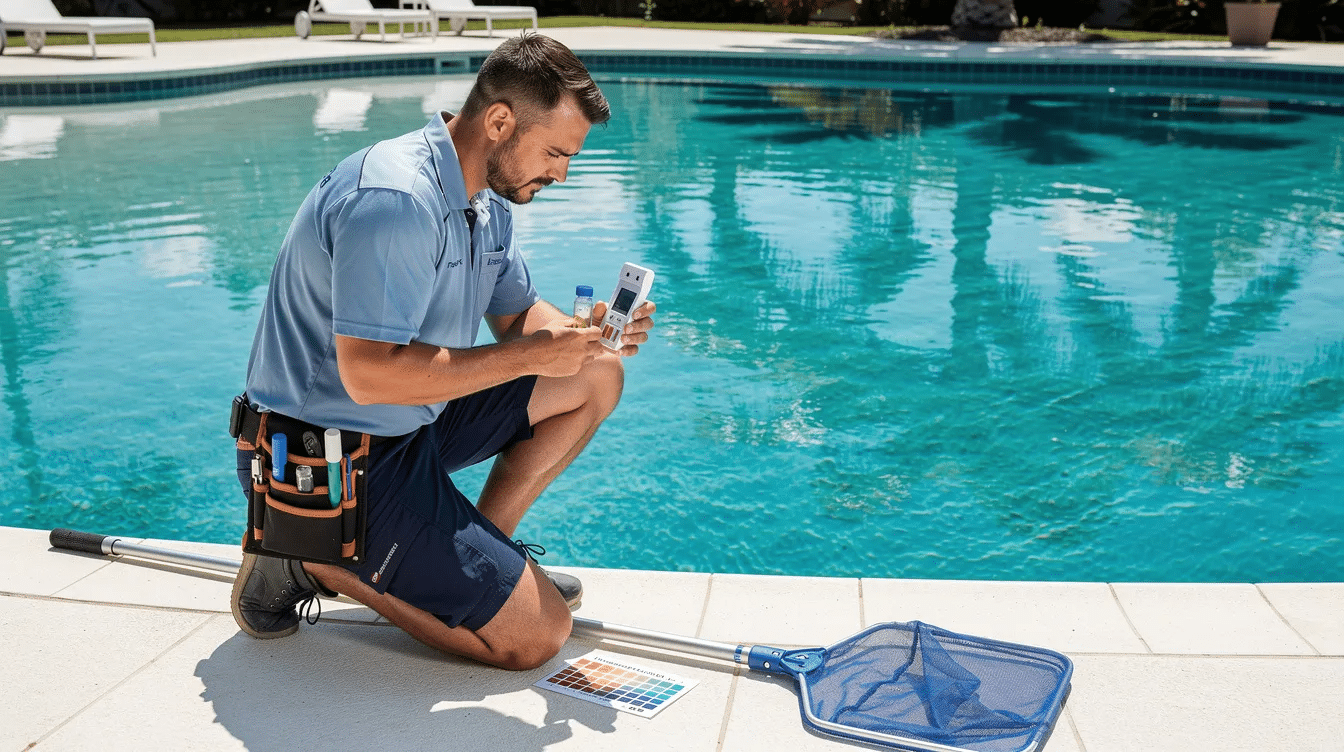
Many pool enthusiasts believe that keeping a pool’s water clear is equivalent to keeping it safe, however, this is not entirely true. Pool professionals understand that safety always comes first, and sometimes, clear water might not be safe. Pool sanitation involves precise chemistry, and knowing what occurs at a molecular level will impact how you clean your pool during seasonal changes, what equipment you purchase, and which pool chemicals you use.
Why pH Is The Master Variable
pH is the most important factor when it comes to keeping your pool water clean and safe. You can have the right amount of sanitizer in your pool, but if pH isn’t within the optimal range of 7.4 – 7.6, that sanitizer can’t do its job.
pH is important for two reasons. First, it affects the potency of your pool’s sanitizer. The pH scale measures how acidic or basic a substance is on a scale of 0 – 14, with 7 being neutral. Anything below 7 is acidic and anything above 7 is basic. Pool water needs to be slightly basic to inhibit the growth of germs and bacteria. If pH is too low, the sanitizer is more effective, but it can lead to corrosion of equipment and pool surfaces. If pH is too high, the sanitizer will be less effective.
The second reason pH is important is that it affects bather comfort. Water that is too acidic can irritate the skin and eyes, while water that is too basic can cause scaling and cloudy water.
The Filtration Pyramid: Physical Removal Before Chemical Kill
One of the consumer-grade pool care oversights: physical filtration is the first line of defense, not this thing that’s just happening in the background. Your chemical sanitizers have to do more work when your filter isn’t adequately removing particulates, because free chlorine is being eaten up by suspended organic matter before it ever has a chance to address pathogens.
Sand filters run at 20-40 microns. Cartridge filters do a tad better, at 10-20 microns. Diatomaceous earth (DE) filters run at 2-5 microns – which is fine enough to start catching the particles the other two systems are waving right through. That gap in filtration efficiency translates directly into additional chemical demand. A pool running a DE filter will, all else being equal, need less sanitizer to maintain the same standard of water quality as that same pool running a sand filter.
This is particularly relevant during high-load periods: post-storm, after heavy bather use, during the seasonal transitions when there’s an uptick in organic debris. Filtration depth is factored in by the pros as part of the sanitation math, not something that happens over there while they’re doing this over here. The turnover rate is the other physical variable. The pro standard for residential pools is four complete turnovers in 24 hours. It’s your pool volume divided by your pump’s flow and that’s your baseline, irrespective of whatever your filter is.
The Danger Of Over-Stabilization
Cyanuric acid (CYA) is what keeps free chlorine safe from the sun’s UV rays. You really do need it for outdoor pools in sunny climates. Without CYA, direct sunlight can destroy free chlorine residuals by 80% to 90% in just a few hours. The target range for outdoor pools is 30 to 50 ppm CYA.
The trouble with CYA, though, is that it never leaves the system. It doesn’t digest, burn up, or evaporate. And, every time a tablet of trichlor or dichlor floater is added to the pool, some CYA is introduced to the system. Once CYA levels climb above 100 ppm, it begins to chemically tie up the free chlorine, thus rendering it less effective as a bactericide. This threshold is often referred to as chlorine lockout. That’s when you measure free chlorine in the water, but it doesn’t sanitize effectively.
There are no chemicals to break the CYA down or vaporize it. The remedy for high CYA is to partially drain and refill the pool. This is why professionals who handle pool cleaning perth and elsewhere test for CYA each time they visit a pool, rather than relying on test strips that omit the CYA test. If CYA is at 80 ppm, dilute the pool in increments. If the CYA is measured at 150 ppm at the outset of summer, be prepared to replace more water and don’t open until you do.
Seasonal Transitions: The Science Of Opening and Closing
The shift from summer to winter (pool closing) and back is a process that must be carried out correctly to protect your investment and the health of your pool users. While the advent of cooler weather might signal the end of the swimming season for your family, proper pool closing will preserve your pool in good condition for the next summer season. Similarly, pool opening is not quite as simple as unwrapping the cover, and can involve the complicated task of managing the chemistry of an algae-filled pool that spent a few months sitting under wraps. Attention to the transition details safeguards your pool and those who’ll use it.
If a pool doesn’t get properly managed, both spring and fall transitions become costly nightmares. Filters slowly plug, heater exchangers erode to pitting, plaster etches and delaminates, covers deteriorate, and that’s just the most evident results. Pools that don’t get winterized right, opened right, and maintained through the season will die in 15 years when they should easily last four times that. The important part of every spring and fall opening/closing isn’t the batch of existing customers safely opened or closed, it’s the future repairs that are avoided by as many of those customers as possible.
Breakpoint Chlorination and Chloramine Elimination
Chloramines are the smell people recognize as ‘too much chlorine’ in the pool. However, it is not caused by too much chlorine but by insufficient free chlorine to oxidize the organic load introduced by swimmers, which leads to chloramine formation. This does not mean that recreational water can’t contain too much chlorine. Pool readings for free available chlorine should be in the 2-4 ppm range with pH within the 7.2-7.6 normal range.
Eliminating chloramines requires breakpoint chlorination: adding free chlorine to a level approximately ten times the combined chlorine reading. At that concentration, the oxidation reaction goes to completion and chloramines are destroyed. Below that threshold, you add more chlorine without actually fixing the problem. This is why shock treatments require correct dosing based on water test results, not just “a bag of shock” added on a schedule. Under-dosing doesn’t reach breakpoint and the combined chlorine problem persists.
Advanced Pathogen Control: UV, Ozone, and What Chlorine Can’t Do Alone
According to the Centers for Disease Control and Prevention’s Healthy Swimming guidelines, _Cryptosporidium_ can live in properly chlorinated pool water – 1 ppm free chlorine at pH 7.5 – for 10.4 days. That’s not a chlorine failure; it’s a protozoan with a chlorine-resistant oocyst wall property. Standard chlorine chemistry at residential concentrations just can’t destroy it in any reasonable contact time.
UV sterilizers and ozone generators close this gap. UV systems expose water to high-intensity ultraviolet light that disrupts the DNA of pathogens on contact – including _Cryptosporidium_ and _Pseudomonas_ – without adding anything to the water chemistry. Ozone generators contribute ozone gas that oxidizes organic material and destroys pathogens much faster than chlorine before breaking down back into oxygen.
Both systems are secondary sanitation – they work in-line with the existing circulation system and reduce the chemical demand on chlorine. They do not replace chlorine, as chlorine provides the residual protection that UV and ozone can’t. But for pools with high bather loads, immunocompromised users, or facilities in which the risk of waterborne illness should be kept to a minimum, these systems represent the professional standard.
The Langelier Saturation Index: Protecting The Investment
The LSI is a mathematical calculation that takes pH, total alkalinity, calcium hardness, TDS, and water temperature and produces a single number that tells you whether pool water is corrosive, balanced, or scale-forming.
A negative LSI (below -0.3) means corrosive water – it will etch plaster, attack grout, and accelerate wear on pool heaters and salt cells. A positive LSI (above +0.3) means scale-forming water – calcium carbonate deposits will build on surfaces, inside heater heat exchangers, and on salt cell plates, reducing their efficiency.
The target range is -0.3 to +0.3. Seasonal temperature swings affect the LSI directly because water temperature is a variable in the formula. Professionals recalculate the LSI when water temperature changes significantly – which is exactly when most pool owners aren’t thinking about chemistry at all.
Calcium hardness sits in this equation as an important variable. The target range is 200-400 ppm. Low calcium hardness in a negative LSI environment accelerates surface etching and shortens the life of plaster finishes. It’s not dramatic, but over seasons and years, water that’s consistently aggressive dissolves thousands of dollars of pool infrastructure.
What Professional Methodology Actually Looks Like
What sets professional pool care apart from DIY maintenance isn’t better equipment or chemicals, it’s the method. Every time you add a chemical, you perform a test. Every result is cross-referenced with several other readings, rather than looking at them one by one. For example, you calculate your shock dosage based on your combined chlorine reading. You check your Langelier Saturation Index before adding calcium. You monitor your CYA levels over time to know when it’s time to add fresh water.
Your skimmer, on the other hand, doesn’t do chemistry. It’s an important tool, but it’s not going to keep your water safe. The real work is in the water chemistry, the filtration calibration, and the seasonal protocols that keep a pool genuinely safe rather than just visibly clear.
